
Symbiotic for CISOs
Say yes to AI coding, with proof.
Symbiotic Code applies your security policy to every AI-assisted change, runs the agent in a sandbox, and keeps an exportable record of every action. Engineering ships at AI speed, and you have the evidence to show the board.







What a security team gets from a harness that secures code at the source
0hrs
Saved per developer every month by removing all security friction
0%
Average AI cost reduction thanks to our auto-routing system
0min
For a Claude Code user to be productive on Symbiotic Code
01
Guardrails applied, then verified
Your guardrails apply before the model writes, and the model can't skip them. Every change is then checked against them before it's handed back.
02
Checked before it reaches you
All code the agent delivers has been scanned, fixed where needed, and verified against your policy, so it's safe to use.
03
Security in every place code is written
The same policy governs the terminal, the IDE, the pull request, and CI. Nothing slips between stages.
04
Secrets and PII stay out of prompts
Credentials, personal data, and confidential information are removed before any request reaches a model.
05
Code born secure
Vulnerabilities, vulnerable dependencies, hard-coded secrets, and authentication and authorization gaps get fixed while the agent writes.
06
Guardrails built from what you already have
Generate them from your security documentation, let the agent discover rules from your codebase, or start from an industry template.
Your code stays yours
You decide what leaves your environment. Run Symbiotic Code on our cloud, on yours, or on-prem, where nothing leaves at all.
In privacy mode, no code is stored anywhere. Detection runs on your side, prompts are redacted before any model call, and findings contain no code snippets. Every cloud call runs under zero data retention.
The agent your developers want, with the controls you need
Your developers keep their plans, diffs, subagents, MCP servers, and CLAUDE.md files. Your policy runs underneath, before the agent writes a line.
Guardrails applied and verified
They apply before the model writes, and every change is checked against them.
Agents under your rules
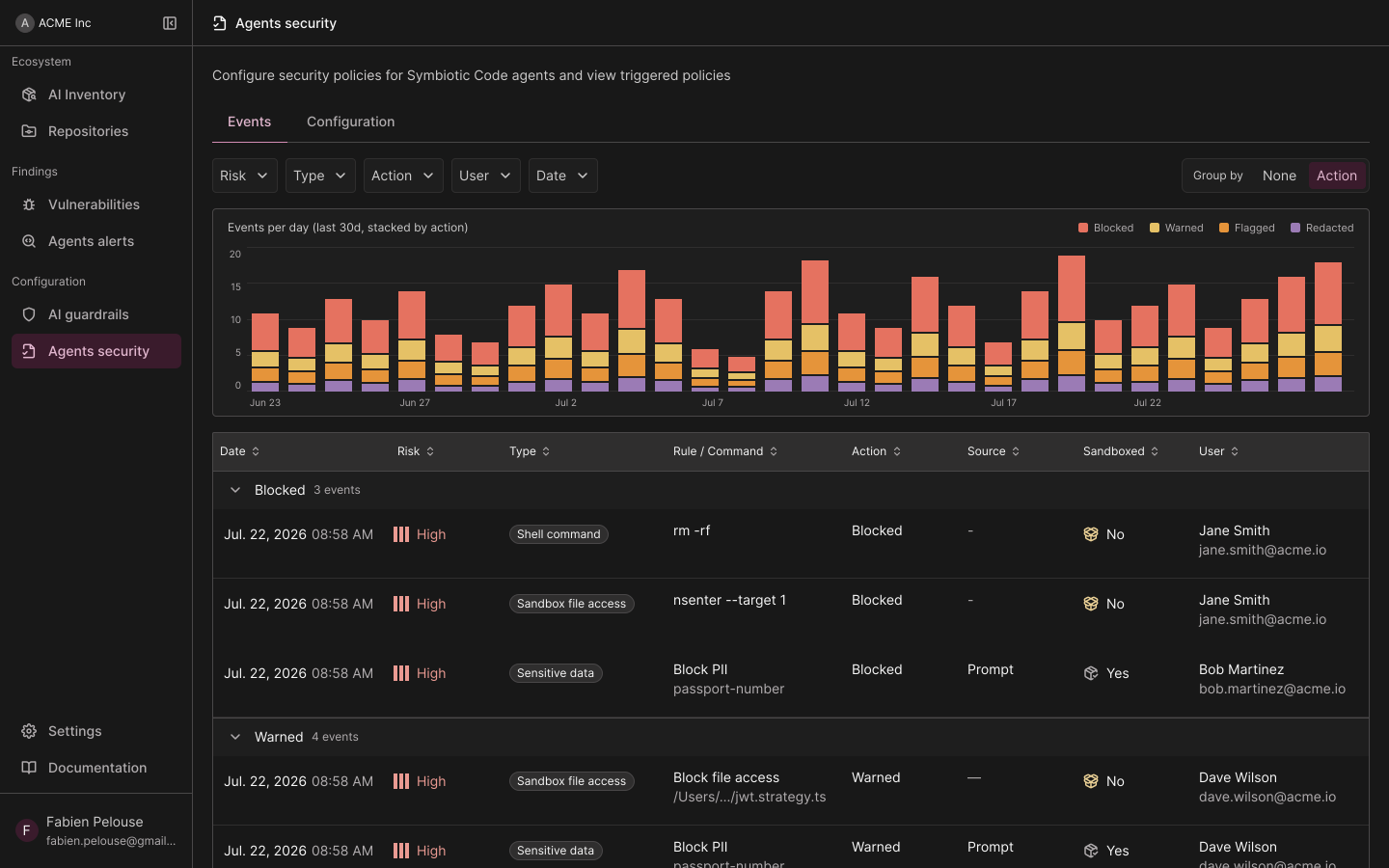
Sandbox, network and command policies, and credential and PII guards, configured centrally.
Evidence on demand
A trail of what was flagged, fixed, and verified on every AI-assisted change, ready to export.
A stack that stays yours
Bring your own models and keys, deploy on our cloud, yours, or on-prem, and change model providers without changing the harness.
Built for the whole team
See how Symbiotic Code works for the rest of your team.
Access the models you love, keep your costs down with turn-by-turn smart routing, and bring your own LLM for privacy





Questions & answers
Will my code be used to train AI models?
No. Your code is never used for training, by Symbiotic or by any model provider. All cloud LLM calls run through our own tenant under a Zero Data Retention policy.
Can Symbiotic Code access my filesystem or source code without permission?
No. Security scanners only read the files the agent is working on: typically modified files, at most the current repository. The agent itself runs in a sandbox with configurable access policies and destructive commands are blocked by default.
Doesn't the agent certify its own work?
No single system grades its own homework. The agent that writes code and the system that verifies it are separate by design: distinct agentic roles, a deterministic scanning layer with no AI in it, and different reasoning processes for generation and review.
Can we stay hosted in the EU?
Yes. EU hosting comes standard.
How are AI requests routed, and who has access to them?
Through our own Amazon Bedrock tenant with Zero Data Retention. Model providers process and discard; they store nothing. In privacy mode, no code is stored anywhere.
Where do LLM executions actually run?
Your choice of three modes. Classic: through our Bedrock tenant. Privacy: same flow, with no code stored anywhere. Self-hosted: your own models on your own infrastructure, and none of your code leaves your perimeter. Our research team fine-tuned a 22B open model that matches Claude Opus 4.8 on the CyberSecEval remediation benchmark while running on-premise. Read the research
PRIVACY
Will my code be used to train AI models?
No. Your code is never used for training, by Symbiotic or by any model provider. All cloud LLM calls run through our own tenant under a Zero Data Retention policy.
Can Symbiotic Code access my filesystem or source code without permission?
No. Security scanners only read the files the agent is working on: typically modified files, at most the current repository. The agent itself runs in a sandbox with configurable access policies and destructive commands are blocked by default.
Doesn't the agent certify its own work?
No single system grades its own homework. The agent that writes code and the system that verifies it are separate by design: distinct agentic roles, a deterministic scanning layer with no AI in it, and different reasoning processes for generation and review.
Can we stay hosted in the EU?
Yes. EU hosting comes standard.
How are AI requests routed, and who has access to them?
Through our own Amazon Bedrock tenant with Zero Data Retention. Model providers process and discard; they store nothing. In privacy mode, no code is stored anywhere.
Where do LLM executions actually run?
Your choice of three modes. Classic: through our Bedrock tenant. Privacy: same flow, with no code stored anywhere. Self-hosted: your own models on your own infrastructure, and none of your code leaves your perimeter. Our research team fine-tuned a 22B open model that matches Claude Opus 4.8 on the CyberSecEval remediation benchmark while running on-premise. Read the research