
Symbiotic for financial services
AI coding your examiners can sign off on.
Symbiotic Code enforces your security policies as code is written, keeps credentials and customer data out of every prompt, and gives your auditors the evidence on demand. Run it on our cloud, yours, or inside your own perimeter.
Free for teams up to 10 members







What a fintech gets from a harness that secures code at the source
0hrs
Saved per developer every month by removing all security friction
0%
Average AI cost reduction thanks to our auto-routing system
0hr
For a Claude Code user to be productive on Symbiotic Code
01
Centralized security controls
Model access, MCP servers, skills, and rules configured once and enforced on every team and repo. SOC 2, ISO 27001.
02
Zero data retention
No training on your code, by Symbiotic or any model provider. Cloud LLM calls are processed, then discarded.
03
Credentials never reach a model
Secrets, PII, and account data are removed from prompts before they leave your environment. PCI-DSS v4.
04
Evidence for the examiner
A full trail of what was flagged, fixed, and verified on every AI-assisted change. PCI-DSS Requirement 6, DORA.
05
Secure-coding training on record
Just-in-time exercises and assessments tied to real findings, with records you can produce at audit time. PCI-DSS 6.2.2.
06
Third-party AI risk under control
Every agent, MCP server, and plugin inventoried and allow-listed. DORA ICT third-party risk, NIS2.
Your code stays yours
Banks and insurers don't hand their codebase to someone else's cloud. You choose what leaves your environment, including nothing at all.
In privacy mode, no code is stored anywhere. Detection runs on your side, prompts are redacted before any model call, and findings contain no code snippets. Every cloud call runs under zero data retention.
The agent your developers want, with the controls you need
Plans, diffs, subagents, MCP servers, and your existing CLAUDE.md: all of it works the way your team already works. The difference is what happens before the code reaches you
Payment code that passes review
Guardrails built from your PCI-DSS controls apply before the agent writes a line, and every fix is verified before it hands back.
No secrets in the repo, or the prompt
Hard-coded credentials are caught at generation, and credential detection stops them reaching the model at all.
Automated fixes in the PR
Findings land in the pull request with a remediation attached. Reviewers approve fixes instead of asking for them.
A board-grade answer on AI
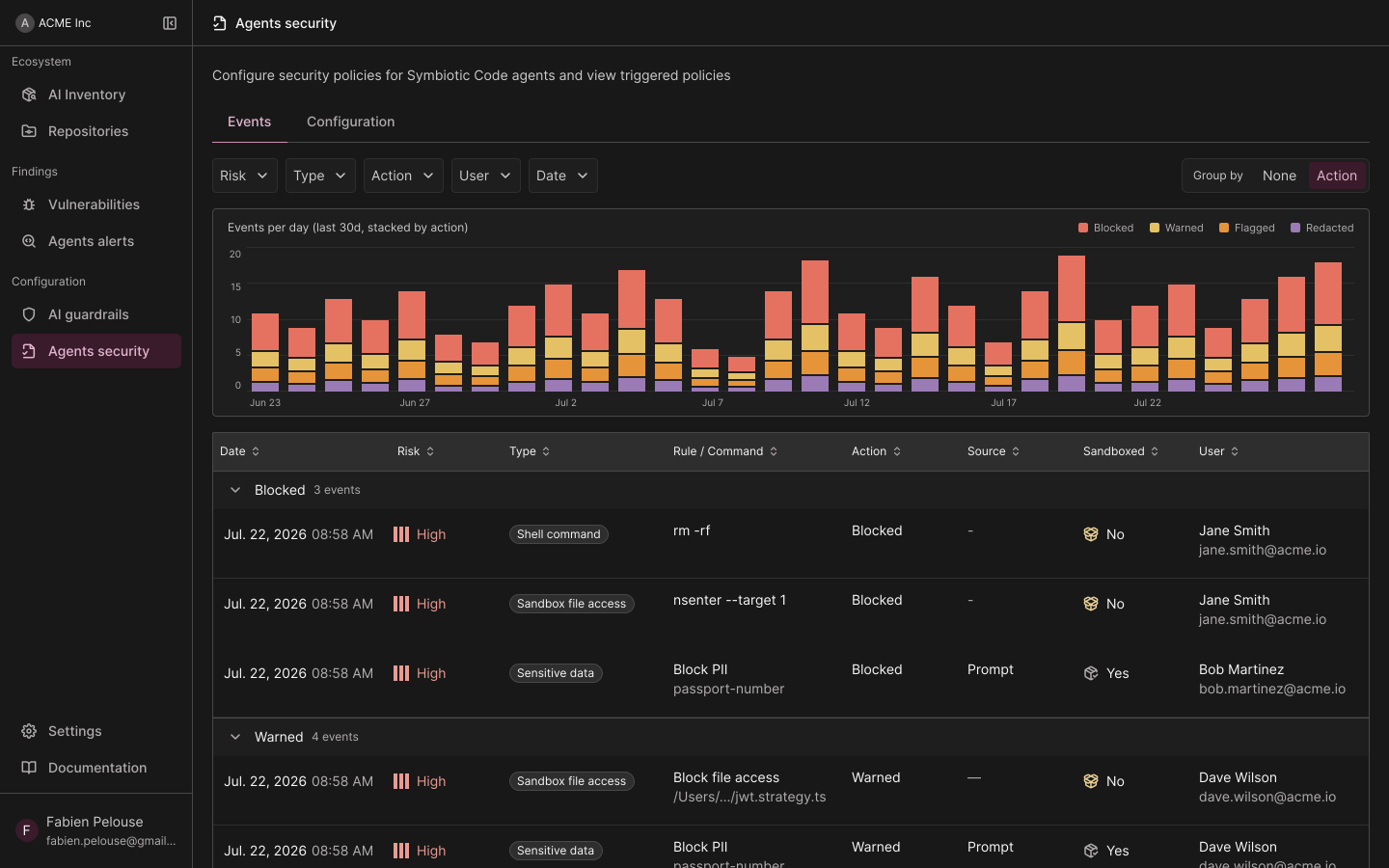
Sandboxed agents, traced actions, and an audit trail streamed to your SIEM. All the evidence your regulator asks is already there.
Access the models you love, keep your costs down with turn-by-turn smart routing, and bring your own LLM for privacy


Questions & answers
Will my code be used to train AI models?
No. Your code is never used for training, by Symbiotic or by any model provider. All cloud LLM calls run through our own tenant under a Zero Data Retention policy.
Can Symbiotic Code access my filesystem or source code without permission?
No. Security scanners only read the files the agent is working on: typically modified files, at most the current repository. The agent itself runs in a sandbox with configurable access policies and destructive commands are blocked by default.
Doesn't the agent certify its own work?
No single system grades its own homework. The agent that writes code and the system that verifies it are separate by design: distinct agentic roles, a deterministic scanning layer with no AI in it, and different reasoning processes for generation and review.
Can we stay hosted in the EU?
Yes. EU hosting comes standard.
How are AI requests routed, and who has access to them?
Through our own Amazon Bedrock tenant with Zero Data Retention. Model providers process and discard; they store nothing. In privacy mode, no code is stored anywhere.
Where do LLM executions actually run?
Your choice of three modes. Classic: through our Bedrock tenant. Privacy: same flow, with no code stored anywhere. Self-hosted: your own models on your own infrastructure, and none of your code leaves your perimeter.
PRIVACY
Will my code be used to train AI models?
No. Your code is never used for training, by Symbiotic or by any model provider. All cloud LLM calls run through our own tenant under a Zero Data Retention policy.
Can Symbiotic Code access my filesystem or source code without permission?
No. Security scanners only read the files the agent is working on: typically modified files, at most the current repository. The agent itself runs in a sandbox with configurable access policies and destructive commands are blocked by default.
Doesn't the agent certify its own work?
No single system grades its own homework. The agent that writes code and the system that verifies it are separate by design: distinct agentic roles, a deterministic scanning layer with no AI in it, and different reasoning processes for generation and review.
Can we stay hosted in the EU?
Yes. EU hosting comes standard.
How are AI requests routed, and who has access to them?
Through our own Amazon Bedrock tenant with Zero Data Retention. Model providers process and discard; they store nothing. In privacy mode, no code is stored anywhere.
Where do LLM executions actually run?
Your choice of three modes. Classic: through our Bedrock tenant. Privacy: same flow, with no code stored anywhere. Self-hosted: your own models on your own infrastructure, and none of your code leaves your perimeter.