
Symbiotic for AppSec teams
Stop the backlog from refilling.
AI writes more code than your team can review, and scanners already find more than developers fix. Symbiotic Code enforces your policy as code is written and fixes vulnerabilities in the loop, so new ones stop landing in your backlog.






What an AppSec team gets from a harness that secures code at the source
0hrs
Saved per developer every month by removing all security friction
0%
Average AI cost reduction thanks to our auto-routing system
0min
For a Claude Code user to be productive on Symbiotic Code
01
Code born secure
Vulnerabilities, vulnerable dependencies, hard-coded secrets, and authentication and authorization gaps get fixed while the agent writes.
02
Guardrails applied, then verified
Your guardrails apply before the model writes, and the model can't skip them. Every change is then checked against them before it's handed back.
03
Your own detection rules
Turn company-specific policies into custom detection rules, applied by the agent and checked after every change.
04
Checked before it reaches you
All code the agent delivers has been scanned, fixed where needed, and verified against your policy, so it's safe to use.
05
Secrets and PII stay out of prompts
Credentials, personal data, and confidential information are removed before any request reaches a model.
06
The whole SDLC, one policy
The same detection and remediation engine runs in the terminal, in VS Code and JetBrains, over MCP, on GitHub and GitLab pull requests, and in CI.
Your code stays yours
You decide what leaves your environment. Run Symbiotic Code on our cloud, on yours, or on-prem, where nothing leaves at all.
In privacy mode, no code is stored anywhere. Detection runs on your side, prompts are redacted before any model call, and findings contain no code snippets. Every cloud call runs under zero data retention.
The harness enforces security, so your developers don't have to think about it.
Developers keep their plans, diffs, subagents, MCP servers, and CLAUDE.md files. Your policy applies before the agent writes, and every change it hands back has been verified against it.
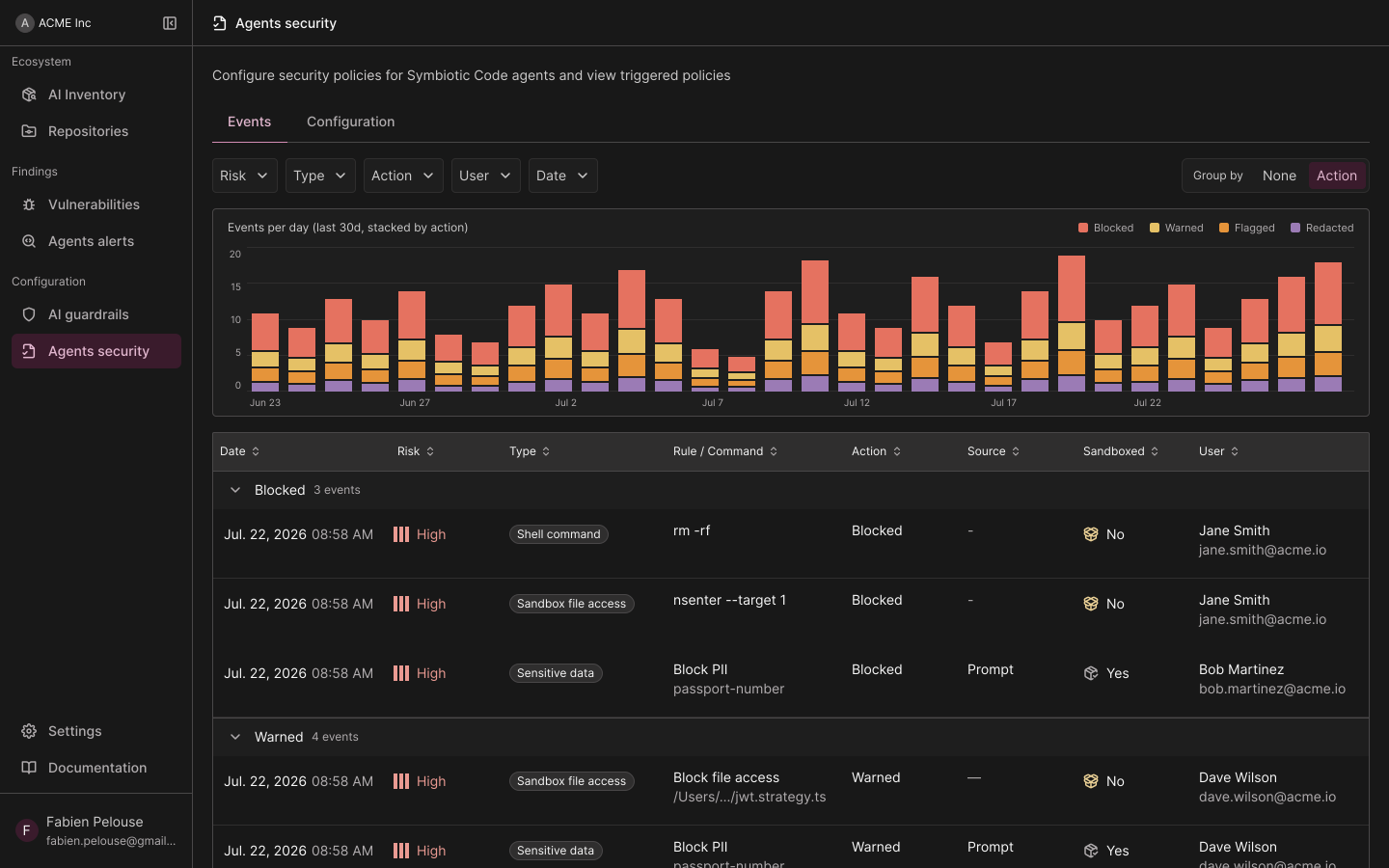
Stopped as it's written
Vulnerabilities are caught while the agent writes, so they stay out of your backlog.
Agentic remediation
The agent fixes what slips through and re-checks the code before delivering it.
One policy, IDE to CI
The same rules in the terminal, the IDE, the pull request, and the pipeline.
Training in the flow of work
Every fix doubles as a just-in-time lesson, with records for your training mandates.
Built for the whole team
See how Symbiotic Code works for the rest of your team.
Access the models you love, keep your costs down with turn-by-turn smart routing, and bring your own LLM for privacy





Questions & answers
We already run Snyk / Veracode / Checkmarx. Why add this?
Keep them and use use Symbiotic Code to stop AI from generating new issues at an AI speed you can’t match. Or use our IDE, VCS, and CI integrations as a replacement.
What does it actually catch?
OWASP classes, AST-level flaws, vulnerable dependencies, secrets, logic issues, PII in code and prompt, and many other code mistakes that put your apps and data at risk.
Can we enforce our own security policies?
Yes. Guardrails are generated from your policies and custom detection rules, then applied at generation time across terminal, IDE, and PR.
How do you handle false positives?
A dedicated LLM-as-a-Judge process reviews each finding, flags the verdict inline in the code, and reports it centrally so it never blocks the loop. It’s crazy accurate.
How do I know a fix didn't break something?
Every fix is re-scanned and tested before the agent can finish.
CODE SECURITY
We already run Snyk / Veracode / Checkmarx. Why add this?
Keep them and use use Symbiotic Code to stop AI from generating new issues at an AI speed you can’t match. Or use our IDE, VCS, and CI integrations as a replacement.
What does it actually catch?
OWASP classes, AST-level flaws, vulnerable dependencies, secrets, logic issues, PII in code and prompt, and many other code mistakes that put your apps and data at risk.
Can we enforce our own security policies?
Yes. Guardrails are generated from your policies and custom detection rules, then applied at generation time across terminal, IDE, and PR.
How do you handle false positives?
A dedicated LLM-as-a-Judge process reviews each finding, flags the verdict inline in the code, and reports it centrally so it never blocks the loop. It’s crazy accurate.
How do I know a fix didn't break something?
Every fix is re-scanned and tested before the agent can finish.